Framing & Printing
Framing & Printing Ideas.
How will your artwork look on the wall?
Choosing the right print and frame can completely change the character of a piece of artwork. Whether you’re looking for something traditional and timeless or clean and contemporary, there are plenty of ways to present a Spike The Art print.
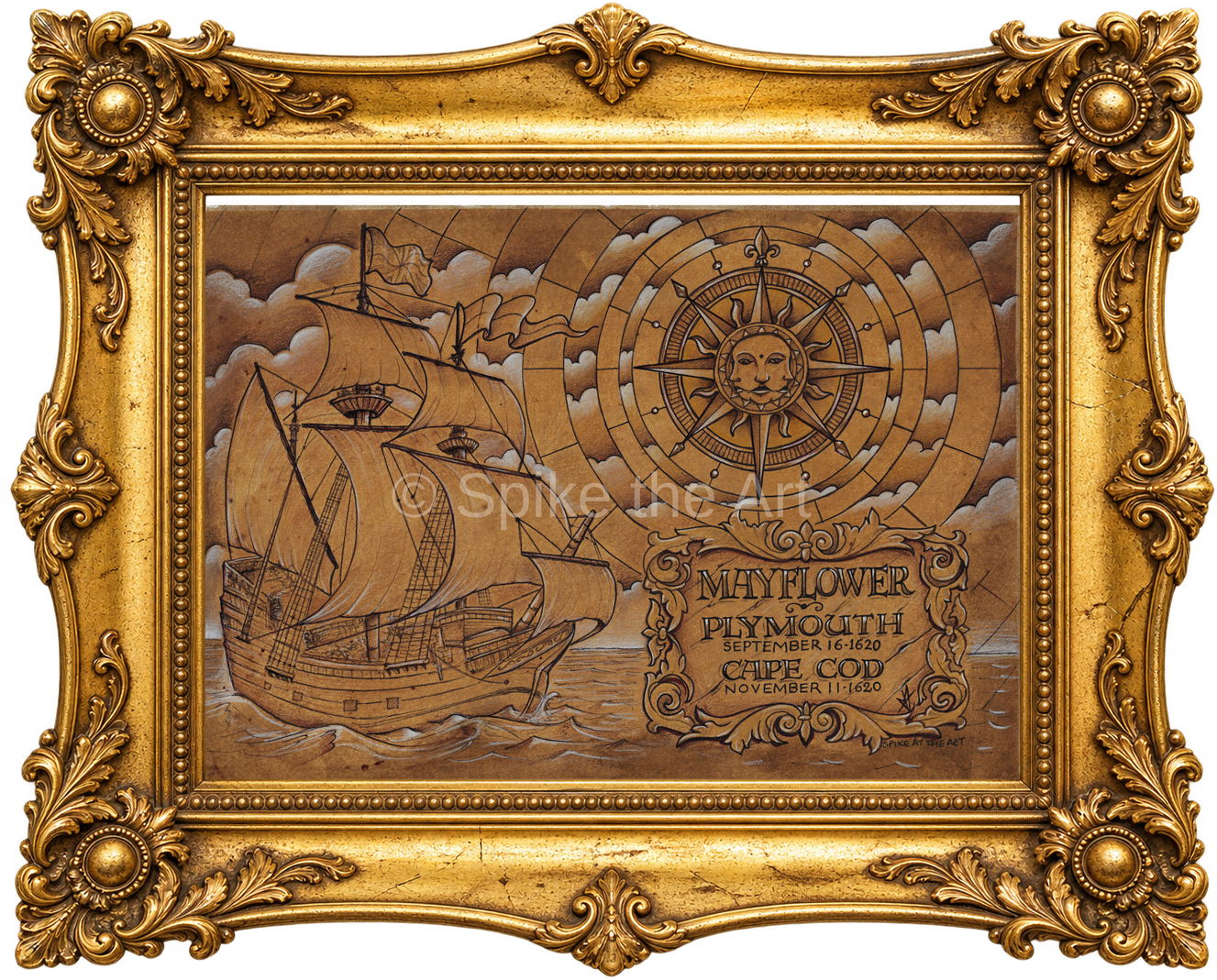
The artwork has a strong connection with history, Plymouth and the story of the Mayflower, so traditional framing can work beautifully — but don’t be afraid to give historical artwork a modern setting.
Classic and timeless
For artwork inspired by the Mayflower, Plymouth and American history, a traditional frame can create a natural connection with the subject.
Think dark wood, aged finishes, warm oak or antique-style frames, perhaps combined with a cream or off-white mount. This works particularly well in period properties, studies, libraries and rooms with traditional furniture.
A generous mount can also give the artwork a little breathing space and make the piece feel more like a traditional gallery print.
Clean and contemporary
Historical artwork doesn’t have to look old-fashioned.
A simple black, white or natural wood frame can give a Mayflower or Plymouth print a much more contemporary feel. Minimal framing allows the artwork itself to become the focal point and works particularly well in modern homes, offices and minimalist interiors.
For a strong image, sometimes less really is more.
The gallery look
For a more sophisticated presentation, consider a larger print with a wide mount and a simple frame.
The extra space around the artwork can make a surprisingly big difference. It gives the image room to breathe and creates the feeling of a professionally presented gallery piece without distracting from the artwork.
This approach can work particularly well when displaying several pieces together.
Create a historical collection
Why choose just one?
Several Spike The Art prints can be displayed together to create a small collection telling the story of the Mayflower and the journey from Plymouth to the New World.
You could combine different subjects — ships, people, places and historic events — using matching frames for a coordinated display, or deliberately mix frame styles for a more eclectic look.
A collection of smaller prints can also make a striking feature wall.
Printing ideas
The choice of paper can be just as important as the frame.
For historical artwork, a fine-art or archival-quality paper can complement the subject beautifully, particularly where the artwork has a painterly or traditional character.
For a more contemporary appearance, a smooth, high-quality art paper can produce a cleaner presentation with crisp detail and strong contrast.
If you’re unsure which approach would suit your chosen artwork, consider the room first. The same image can look completely different depending on the paper, size, mount and frame you choose.
What size should I choose?
There isn’t a single perfect size.
A smaller print can work beautifully on a shelf, desk or within a gallery wall, while a larger print can turn a single piece of artwork into a real focal point.
Before choosing your size, measure the wall space and consider what will surround the artwork. Remember to allow for the frame and mount, not just the printed image itself.
For larger walls, don’t automatically assume that bigger is better. A well-proportioned print with a generous mount can often have more impact than an oversized image squeezed into the available space.
Framing is part of the artwork
Ultimately, there are no hard rules.
A traditional Mayflower scene can look fantastic in an antique-style frame — or completely at home in a sleek modern black frame. The best choice is the one that works with your space and reflects your own taste.
The important thing is that the artwork means something to you.
Whether you’re buying a print because of your connection with Plymouth, the Mayflower, Cape Cod, American history, or simply because you love the image, choose a presentation that makes you want to look at it every day.
The artwork tells the story. The frame sets the scene.
When you purchase and download your print from Spike The Art, the resolution will be sufficient for your print and framing requirements. With file sizes ranging from 70 – 120mb and resolutions as high as 12,000px wide. Whatever size you choose to print it at, your artwork will always look great without pixelisation.

Since 2004
Spike the Art began in 2004, and more than two decades later the name remains part of my creative journey. During those years I’ve been fortunate to work alongside some incredibly talented artists, watch people develop their own creative voices and spend a lifetime surrounded by artwork, ideas and stories.
Through all of it, I’ve never stopped drawing. The direction of my work may have changed, but that curiosity has never gone away. Today, I’m following the stories that interest me, creating artwork inspired by the history, people and places that continue to capture my imagination.
The name is Spike the Art. The place is Plymouth. The journey continues.